.png?width=1656&height=121&name=rsz_%EB%A1%9C%EA%B3%A0%ED%88%AC%EB%AA%85%20(8).png "Pearson & Partners Logo")
Hiring in Korea: What Foreign Employers Get Wrong
.jpg?width=45&name=%ED%94%BC%EC%96%B4%EC%8A%A8%20%EB%A1%9C%EA%B3%A0%20(1).jpg)
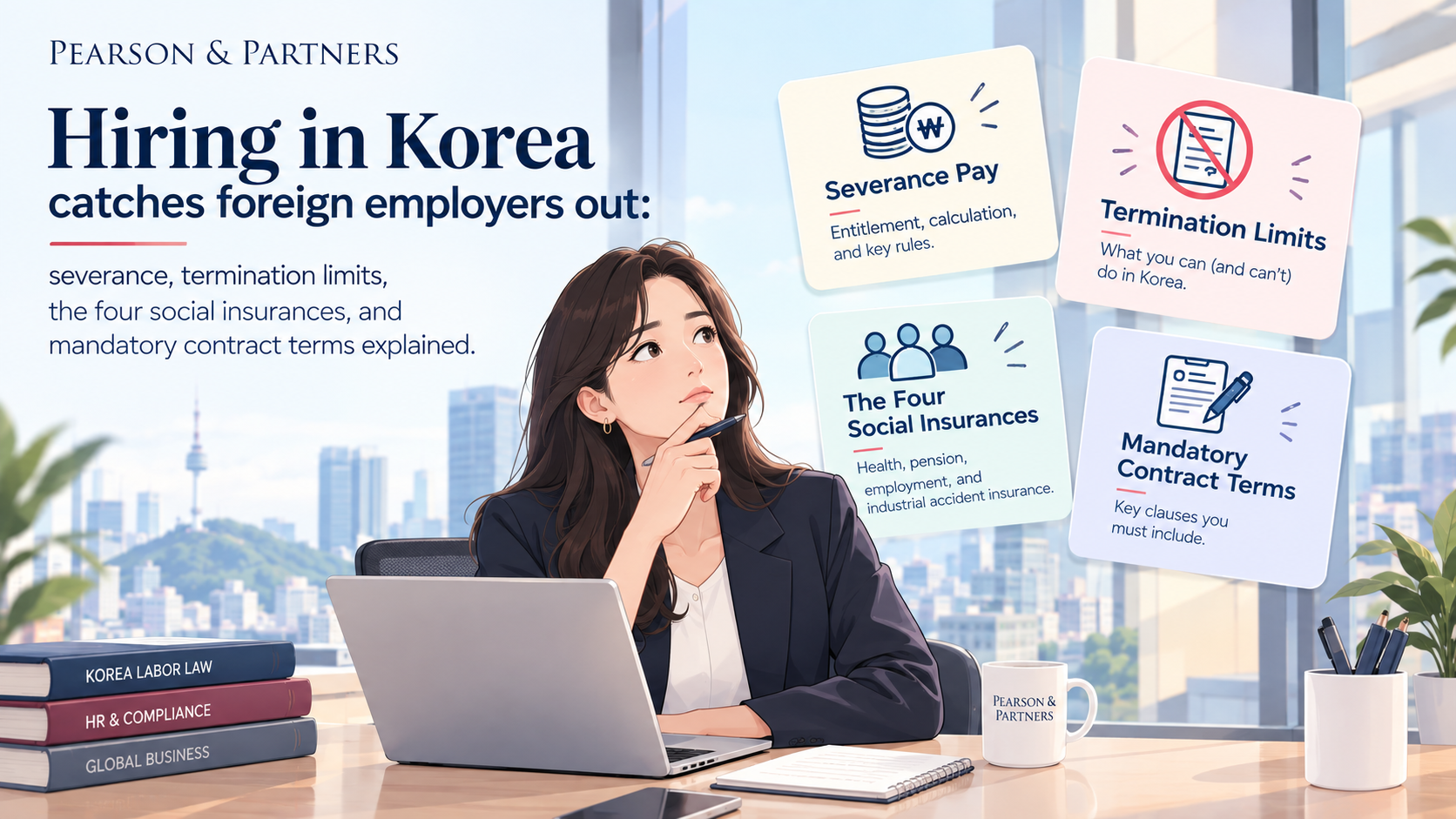
Hiring in Korea looks straightforward until the first thing goes wrong. A foreign employer signs a contract that would be unremarkable in London or San Francisco, then discovers eighteen months later that they cannot let the person go, that a severance liability has been quietly accruing since day one, and that the probation clause they relied on does not do what they assumed.
None of this is obscure. It is simply that Korean employment law is built on different assumptions from the ones most foreign employers bring with them. This guide covers what those assumptions are, where foreign companies most often get caught, and what you can do about it before you make an offer rather than after.
Korean Employment Law Starts From a Different Place
In many markets, employment is presumed terminable. In Korea, the presumption runs the other way. Employment is treated as ongoing, and ending it requires justifiable cause. That single difference reshapes almost everything downstream: how you write contracts, how you manage performance, how you plan headcount, and how much risk sits in a hire you are unsure about.
Foreign employers who internalize this early tend to hire more carefully and sleep better. Those who do not tend to learn it during a dispute.
Planning your first hires in Korea? Talk to Pearson & Partners Korea before the offer goes out, not after the contract is signed.
Severance Is Not Optional
Statutory severance is the single most common surprise for foreign employers hiring in Korea. Employees who meet the service and hours thresholds are entitled to a severance payment on departure, and this is a legal entitlement rather than a discretionary benefit you choose to offer.
Two things follow from that. First, severance accrues from the start of employment, which means it is a liability building on your books from month one, not a cost that appears at the end. Second, it is generally owed regardless of how the employment ends, so an employee who resigns voluntarily may still be entitled to it.
Companies that budget salary without budgeting severance consistently understate the cost of their Korean team. The exact calculation depends on tenure and average wage, and the rules around eligibility and payment timing are set by statute, so confirm the specifics for your situation rather than estimating.
Termination Is Genuinely Difficult
This is the point where foreign employers are most often caught out, because the gap between expectation and reality is widest.
Dismissal in Korea generally requires justifiable cause and proper procedure. Poor performance is not automatically sufficient on its own, particularly where the employer cannot show that it documented the problem, gave the employee an opportunity to improve, and considered alternatives. Statutory notice requirements apply, and dismissals that fail the test can be challenged, with remedies that may include reinstatement.
The practical consequences for how you operate:
- Hire slowly. The cost of a wrong hire is higher here than in at-will markets.
- Document performance from the start. Contemporaneous records matter enormously if a dismissal is ever challenged.
- Do not rely on probation as an escape hatch. Probation periods exist but do not give you a free hand, and the protections are weaker than foreign employers expect.
- Treat restructuring as its own process. Redundancy for business reasons has its own requirements and is not a shortcut around performance management.
The Four Major Social Insurances
Every employer in Korea must enrol employees in the four mandatory social insurances: national pension, national health insurance, employment insurance, and industrial accident compensation insurance.
These are shared between employer and employee, with the employer deducting the employee portion from payroll and paying its own contribution on top. Industrial accident insurance is generally borne by the employer alone.
What catches foreign employers out is not the existence of the insurances but the administration: enrolment must happen promptly when someone joins, contributions are reported and paid on a schedule, and changes in salary or status trigger adjustments. Contribution rates are set by regulation and revised periodically, so verify current rates when budgeting rather than relying on a figure from an old spreadsheet.
Not sure what your true employer-side cost looks like? Pearson & Partners Korea will model the full picture including insurances and severance accrual.
Working Hours, Overtime, and Leave
Korea has a statutory working time framework with limits on weekly hours including overtime, and overtime generally attracts premium pay. The details differ by company size and by the arrangements in place, and the framework has been reformed in recent years, so confirm what applies to your headcount and sector.
Annual leave is a statutory entitlement that accrues based on service, and unused leave can create payment obligations. Public holidays, parental leave, and other statutory leave categories carry their own rules.
The common foreign-employer mistake is assuming a salaried employee is simply expected to work until the job is done. Korean working time rules apply regardless of how you frame the role internally.
Employment Contracts Must Carry Specific Terms
Written employment contracts are required, and they must set out specified terms including wages and how they are composed, working hours, holidays, and leave. A one-page offer letter that would pass in other markets will not meet the requirement.
Beyond the statutory minimum, a few areas deserve particular attention when hiring in Korea:
- Wage composition. How base pay, allowances, and bonuses are structured affects severance and overtime calculations, so it is worth getting right at the outset.
- Intellectual property assignment. Do not assume your home-country template transfers cleanly.
- Non-competes. Enforceability is limited and fact-dependent. A broad clause copied from elsewhere may not hold.
- Language. A Korean-language contract or a properly prepared bilingual version avoids arguments about what the employee actually agreed to.
Companies with a certain number of employees also need to prepare and file rules of employment, which is an obligation that arrives quietly as a team grows.
Contractors Are Not a Workaround
Foreign employers sometimes try to sidestep all of this by engaging people as independent contractors. Korean authorities look at the substance of the relationship rather than the label on the contract.
If you control someone's working hours, direct how they do the work, provide their equipment, and they work exclusively for you, they are likely an employee whatever the agreement says. Misclassification exposes you to back payment of insurance contributions, severance, and other entitlements, usually at the worst possible moment.
Genuine contractor relationships exist. Using the label to avoid employment obligations does not work.
Where an Employer of Record Fits
Everything above is manageable, but it is real work, and it assumes you have a Korean entity to employ through in the first place.
An Employer of Record gives you a different route. The EOR already has a Korean entity and becomes the legal employer of your staff, taking on contract compliance, payroll, withholding, insurance enrolment, and statutory obligations, while you direct the work day to day. For companies hiring one or two people in Korea, or hiring before incorporation is complete, it removes most of this burden.
It is not a universal answer. If you need to sell into Korea, sponsor a founder visa, grant equity, or build a larger team, your own entity will serve you better. We have written a full comparison of EOR versus establishing your own entity covering where each route stops working.
A Practical Checklist Before You Hire
- Decide whether you are employing through your own entity or an EOR
- Budget the full employer cost including the four insurances and severance accrual
- Prepare a compliant written contract with the statutory terms, in Korean or bilingual
- Confirm wage composition deliberately, since it affects later calculations
- Check visa status if the candidate is a foreign national
- Set up payroll, withholding, and insurance enrolment before the start date
- Put performance documentation practices in place from day one
- Review your IP assignment and confidentiality terms against Korean practice
Work With Pearson & Partners Korea
Pearson & Partners Korea helps foreign companies hire and operate in Korea without walking into these problems. Our service lines cover Employer of Record (EOR) services, payroll and the four mandatory social insurances, company incorporation and branch registration, tax and accounting, and visa advisory including D-8 sponsorship.
Because we run both the EOR and the incorporation side of the business, we are well placed to tell you which route actually fits your hiring plan rather than the one that suits us. And because we handle payroll and compliance for clients on an ongoing basis, the advice comes from doing this work month after month rather than from reading the statute.
More on our approach and services at pearsonkorea.com, and further reading on our Insights hub.
Contact us:
Web: pearsonkorea.com/contactus
Phone: 02 6952 7579
Office: 서울특별시 강남구 영동대로 511, WTC 트레이드타워 30층 (06164)
For official background on employment and labour standards in Korea, the Ministry of Employment and Labor publishes guidance, and KOTRA provides orientation for foreign investors.
Frequently Asked Questions
Can I fire an employee in Korea for poor performance?
It is possible but harder than in at-will jurisdictions. Dismissal generally requires justifiable cause and proper procedure, and performance-based dismissal usually requires documented evidence, an opportunity to improve, and consideration of alternatives.
Do I have to pay severance if an employee resigns?
Statutory severance is generally owed to eligible employees regardless of how employment ends, including voluntary resignation. Treat it as an accruing liability from the start of employment.
What are the four major social insurances in Korea?
National pension, national health insurance, employment insurance, and industrial accident compensation insurance. Enrolment is mandatory and contributions are shared, with industrial accident insurance generally employer-funded.
Can I hire someone in Korea without a Korean entity?
Yes, through an Employer of Record. The EOR's Korean entity becomes the legal employer while you direct the work.
Can I hire Korean staff as contractors instead of employees?
Only where the relationship is genuinely independent. Authorities assess substance over labels, and misclassification exposes you to back payment of contributions and entitlements.
Does a probation period let me dismiss more easily?
Probation exists but offers less protection than foreign employers typically expect. Do not treat it as a no-questions-asked exit.
Do employment contracts have to be in Korean?
Contracts must contain specified statutory terms. A Korean or properly prepared bilingual contract is strongly advisable to avoid disputes over what was agreed.
If you have decided your own entity is the right base for hiring, our company incorporation services cover entity selection, registration, and the foreign investment reporting that follows.
.png)